

How To Draw Notes In Ableton
10. Editing MIDI Notes and Velocities
A MIDI clip in Live contains notes and controller data for playing a MIDI instrument. This instrument tin can exist a virtual instrument in a MIDI track'south device chain (see Affiliate nineteen) or an external synth fed via the rail'due south output routing (see Chapter xv). The MIDI clip (run across 4.7) provides the device with a musical score to play, specifying note pitch, length, position and dynamics (referred to every bit velocity in the MIDI lexicon). MIDI is composed and edited in Alive's MIDI Note Editor.
ten.one Creating an Empty MIDI Clip
MIDI clips are created:
- by recording on a MIDI track (run into Affiliate 17) ;
- or by capturing MIDI (see 17.x) ;
- or by double-clicking an empty Session slot in a MIDI track;
- or by selecting an empty Session slot in a MIDI track and choosing the Create menu's Insert MIDI Prune(s) command;
- or by double-clicking on the track display of a MIDI runway in the Arrangement View;
- or, in the Arrangement View, past selecting a timespan in a MIDI track and choosing the Create menu's Insert MIDI Clip(south) command.
10.2 The MIDI Notation Editor
To bring up the MIDI Note Editor, double-click a MIDI prune to open the Clip View. You tin and then cull from any of the three Clip View tabs by clicking their tab headers, or using the following key combinations:
- ALT-1 switches to the Notes tab/console
- ALT-2 switches to the Envelopes tab/console
- ALT-3 switches to the Notation Expression tab/panel
Depending on which Prune View tab/panel is called, the Prune View will bear witness different information. You can read more than about these tabs/panels in the Clip View chapter (run into Chapter eight).
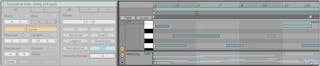
When the Notes tab/console is visible, the MIDI Note Editor is divided into two editing windows: the upper MIDI Annotation Editor and the lower Expression Editor lanes (consisting of the MIDI Velocity and MIDI Chance Editor lanes).
While the Velocity Editor lane is shown past default, both it and the Risk Editor lane (described in detail below) can be shown or subconscious via the lane selector toggle buttons at the left. Underneath the lane selector toggle buttons, a triangular toggle button allows showing or hiding all enabled lanes at once. When both lane selectors are hidden pressing the triangular toggle button volition bear witness both lanes at one time.
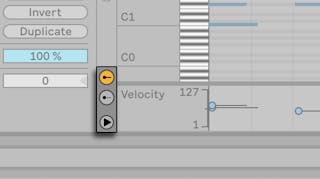
The Velocity and Gamble Editor lanes can exist resized individually via their divide lines, or simultaneously resized by dragging the split line between the lanes and the MIDI Note Editor.
Information technology is also possible to resize the velocity, probability, and per-annotation expression lanes using the mousewheel/pinch gesture while holding the ALT fundamental.

Switch to Draw Mode past activating the Control Bar's Draw Mode switch or by pressing the B central. You can at present draw MIDI notes into the MIDI Annotation Editor with the mouse. Deactivating Draw Mode allows notes to be selected and moved around via clipboard operations or by clicking and dragging, either vertically to change their transposition, or horizontally to change their position in time. MIDI notes tin can also be added and deleted by double-clicking when Draw Way is inactive.
The "Draw Mode with Pitch Lock" toggle in the Record/Warp/Launch preferences lets you lot choose between two different ways of using Describe Mode. When enabled, drawing MIDI notes is constrained to 1 single key rail (or pitch) at a fourth dimension, while property the ALT key allows freehand melodic drawing. When disabled, Depict Mode defaults to freehand melodic drawing, and property the ALT fundamental enables pitch-locked drawing. The melodic Draw Mode can exist used to erase notes, when drawing starts on an existing notation. When the MIDI Note Editor is focused, the "Draw Fashion" entry in the Options and context menus displays the currently selected state of the "Describe Manner with Pitch Lock" preference, as "Pitch Lock On/Off".

Provided your MIDI runway's device concatenation contains an instrument (see Chapter xix), activating the Preview switch in the MIDI Editor allows you to hear notes as you select and movement them. If the MIDI runway is armed, activating Preview also allows y'all to step tape (see 17.three.4) new notes into the clip. Notation that the Preview switch's on/off state applies to all MIDI tracks in the Live Fix.
After cartoon a few notes and moving them around, you will probably want to know how to go around in the MIDI Annotation Editor. So, before we go into detailed editing information, we volition first explain MIDI Editor navigation.
10.three MIDI Editor Navigation and Send
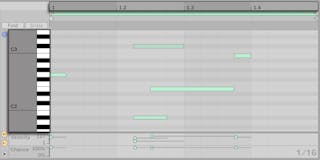
The MIDI Editor has both vertical and horizontal navigation. Along the horizontal axis lies a time ruler, which shows note position along a musical timeline. The vertical axis contains the note ruler, displaying octaves C-ii–C8, and a representation of a piano keyboard (the piano gyre). Note that if the Preview switch at the top of the piano roll is activated, y'all can listen to the results of your piano curlicue playing.
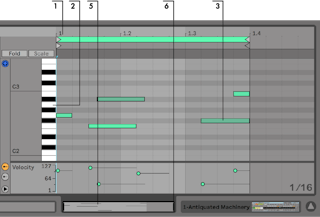
- To smoothly modify the fourth dimension-zoom level, click and drag vertically in the time ruler. Drag horizontally in the time ruler to scroll from left to correct. While scrolling upwardly and downwards using the mousewheel, you tin hold the CTRL(Win) / CMD(Mac) modifier to zoom horizontally, or you tin can hold the ALT modifier to zoom vertically.
- Click and drag vertically in the note ruler to change which octaves are shown, or drag horizontally to change the vertical zoom size of MIDI notes and the keyboard.
- Click and elevate over ane or more notes to select them, or over a portion of the editor's groundwork to select a range of fourth dimension. Then, double-click on the note ruler or time ruler to automatically zoom in on your selection. If naught is selected, double-clicking the note ruler volition zoom in on the expanse from the lowest to the highest note in the clip, while double-clicking the time ruler volition zoom out to show the time between the first and last annotation. Y'all can change the annotation choice using the CTRL(Win) / ALT(Mac) modifier in combination with the upward or downward arrow key.
- To zoom in and out around the electric current selection, apply the computer keyboard's + and - keys.
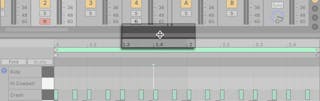
- The Clip Overview just beneath the MIDI Editor tin besides be used for navigation. It always shows the complete contents of the selected MIDI prune. The black rectangular outline represents the function of the clip that is currently displayed in the Editor higher up. To scroll, click within the outline and drag left or correct; to zoom in and out, elevate up and down.
- Change the length of what is shown in the Editor by dragging the left or correct edges of the outline in the Clip Overview.
- To quickly change what is shown in the Editor, click on a section that you want to examine in the Clip Overview, then drag downwards to zoom in, or scroll by dragging left and right.

The area displayed in the MIDI Notation Editor can exist set to coil with playback using the Follow switch from the Command Bar. Follow will break if you brand an edit in the MIDI Notation Editor, and will get-go again once yous stop or restart playback, or click in the Arrangement or prune scrub area.
When Permanent Scrub Areas is enabled in Live'southward Look/Feel Preferences, clicking in the scrub area below the beat-fourth dimension ruler starts playback from that signal, rounded by the global quantization setting. (Tip: activating the Options carte du jour'south Chase MIDI Notes command allows MIDI notes to play back even if playback begins after the MIDI annotation's commencement time.)
When the Permanent Scrub Areas preference is off, you lot tin still scrub by Shift-clicking anywhere in the scrub area or in the beat out-time ruler. Learning about the loop/region controls (encounter 8.4) and associated shortcuts can as well be helpful in getting around in the MIDI Editor and playing selections speedily and easily.
As you work with MIDI, you lot may find yourself needing extra screen space. You can click and drag vertically on the window split between the Session or Arrangement View and the Clip View to enlarge the MIDI Editor.
10.four Editing MIDI
x.iv.1 Non-Subversive Editing
You can always render your MIDI clip to its previous state by using the Edit menu's Disengage command. Furthermore, if the MIDI clip being edited originated in a MIDI file on your hard drive, none of your editing volition alter the original MIDI file, equally Live incorporates its contents into your Live Set when importing.
10.4.2 Scales, Folding and Looping
By highlighting certain notes in the pianoforte roll of a MIDI clip, Scale Mode allows you to hands write melodies within a chosen calibration. Scale Mode tin exist toggled with the Calibration push in the corresponding clip tab/panel. To the right of the Calibration button, Root Note and Scale Name choosers permit setting a root annotation and calibration for the selected clip(southward).
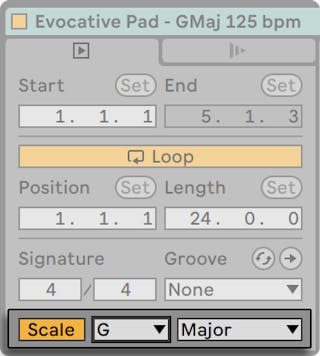
When a selected clip has Scale Mode enabled and a scale is selected, notes belonging to the scale are highlighted in the piano ringlet. Past default, central tracks belonging to the selected scale are highlighted in the MIDI Note Editor, and the root note is indicated by a prominent highlight in the piano roll. Calibration highlighting tin be toggled on or off, by pressing the Chiliad shortcut key while the MIDI Note Editor is in focus, or via the Highlight Clip Scale context menu and View menu entry.
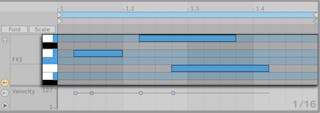
Newly-created MIDI clips inherit the previously edited or viewed prune scale, even if they accept Scale Way disabled. When editing multiple clips with unlike key and scale settings, any foreground clip with Scale Style enabled will update the global setting that is used to create new clips.
When a selected clip has Scale Mode enabled and a scale is selected, pressing the Calibration push to the right of the Fold button will just show cardinal tracks belonging to the chosen calibration. Any fundamental tracks containing notes not in the current scale volition also be displayed.
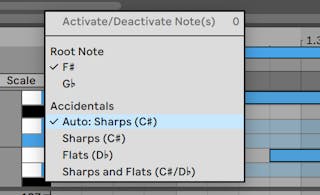
You tin can ready a preference for spelling a clip's notes with flats, sharps, or both, via the pianoforte roll's context carte du jour. When Scale Style is not enabled, this setting applies to all notes, but when Scale fashion is enabled, this preference but applies to notes which are exterior of the called calibration; notes within the scale will maintain their proper accidentals. An additional "Car" pick automatically selects flats or sharps based on the position of the root note in the circle of fifths.
An important feature of the MIDI Note Editor is the Fold button, located in the upper left corner. Activating this button will immediately hide all rows, or key tracks, that exercise not contain MIDI notes in each MIDI clip. This means that the bachelor key tracks in each clip in your Set up will differ, depending on which notes exist in that prune.
This is very useful when working with percussion kits, for example, which are oftentimes mapped out along a keyboard in sections corresponding to percussion blazon (e.g., snares grouped together 2 octaves downward from hi-chapeau cymbals, etc.). When working with a MIDI file created past such a mapping, sometimes merely ane or two of each type of percussion sound is used, and it becomes unnecessary to view the entire keyboard range. (Annotation: folding the MIDI Note Editor is not possible when editing multiple clips (see ten.v).)
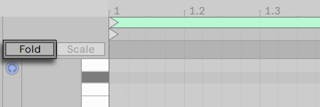
When editing MIDI, you might find that you want to change which part of the clip yous are listening to, or loop the clip in order to listen to it repeatedly. Y'all can use the loop/region markers (meet viii.2.5) for this.
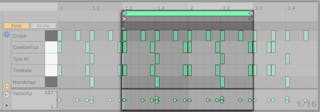
If Fold is deactivated on a track containing a Drum Rack (run across xx.vi), the MIDI Note Editor simply shows rows with notes corresponding to a pad with devices on it. If Fold is activated, only rows containing notes are displayed.
Tip: Selecting the loop brace in a MIDI clip and pressing CTRL-D(Win) / CMD-D(Mac) doubles the length of the loop brace and zooms equally necessary to evidence the entire loop. Whatever notes to the right of the loop volition be moved, so that they maintain their position relative to the terminate of the loop.
10.4.iii Grid Snapping
Almost functions in the MIDI Notation Editor are subject to grid snapping (see 6.nine). But when adjusting events with the mouse, the grid is "magnetic"; event positions tin be moved freely up to the previous or next grid line and then volition snap if you lot proceed to drag. You tin can hold down the ALT(Win) / CMD(Mac) modifier while performing an action to bypass grid snapping.
Note movements volition also snap to an "offset," which is based on the original placement of the note relative to the grid. This is useful for preserving a groove or loose playing style that y'all do not necessarily want to "ready straight."
ten.iv.iv Editing Notes
Editing in the MIDI Note Editor is like to editing in the Arrangement (run across 6.8). In both cases, your actions are selection-based: you select something using the mouse, and so execute a menu command (east.chiliad., Cut, Re-create, Paste, Duplicate) on the selection.
Here is how selection works:
- Clicking a note selects the note. Multiple notes can exist selected in unison: "prophylactic-band" select more than one notation with one mouse movement by clicking in empty space, then dragging to enclose the notes in the dotted line that appears. Esc deselects all selected notes.
- Clicking into the background of the MIDI Notation Editor selects a point in time, represented by a flashing insert marker.
- Clicking and dragging in the groundwork selects a timespan. Printing Enter to toggle the selection between the timespan and whatsoever notes that begin within information technology.
Afterwards placing the insert marker, you lot can manipulate it using your figurer keyboard.
- Press the left or right pointer keys to move the insert mark to the left or right, co-ordinate to the grid settings. CTRL(Win) / ALT(Mac) plus the left or correct pointer keys moves the insert marking to the next annotation boundary.
- Hold downward Shift while pressing the pointer keys to extend or retract the selected timespan by moving the insert marker. ALT(Win) / ALT(Mac) plus Shift while pressing the arrow keys extends or retracts from the opposite side of the pick.
- The insert marker can exist moved to the kickoff or end of a MIDI clip by pressing the Home or End primal, respectively.
As we have seen, notes in the MIDI Note Editor can be moved both horizontally (irresolute their position in time) and vertically (irresolute their transposition). They tin can be moved either past clicking and dragging, or with the arrow keys on your computer keyboard. Notes moved with the arrow keys are always subject to grid and offset snapping, while notes dragged with the mouse can be freely moved until reaching the previous or next grid or offset signal. If yous are playing the clip while you edit notes, you tin can mind to them play in their new assignments as y'all change them.
Several key modifiers also apply to note editing:
- To transpose selected notes by octave, hold down Shift while pressing the up or downwards arrow keys.
- Shift plus the left or right pointer keys extends or retracts the duration of selected notes, co-ordinate to the grid settings. To extend or retract notes without snapping to the grid, also hold ALT(Win) / CMD(Mac).
- To change the choice to the next note in the same primal rail, hold CTRL(Win) / ALT(Mac) while pressing the left or right pointer keys. CTRL(Win) / ALT(Mac) plus the up or down arrow keys moves the choice to the next notation in fourth dimension.
- To nudge notes without snapping to the grid, concord ALT(Win) / CMD(Mac) and printing the left or right arrow keys.
- Y'all can utilize the Shift modifier to click and add individual notes or boosted "rubber-band" selections to your current selection. You tin also remove a single notation from your selection by holding down Shift and clicking on it. Property Shift and clicking on the piano roll adds all notes in a single key rails to the current selection, or removes them if they were already selected.
Selecting a note (or notes) makes it subject area to commands from the Edit menu, such every bit Copy and Paste. Notes in the clipboard will be pasted starting at the location of the insert marker. You lot tin also use the CTRL(Win) / ALT(Mac) modifier to click and drag copies of notes to a new location. If you click and elevate to movement notes but and so decide that you would like to re-create them instead, you tin can press the CTRL(Win) / ALT(Mac) modifier even after starting the drag.
When editing or cartoon, y'all may sometimes place a new note on top of one that already exists. If the new note overlaps with the beginning of the original note, the original note will vanish. If the new note overlaps with the "tail" of the original, the original notation's length will change so that it lasts just until the new note'southward beginning.
10.4.5 Changing Annotation Length
Clicking and dragging on a annotation's left or right edges changes its length. As with note positions, note lengths tin be adjusted freely upward to the previous or next grid line but will be quantized when dragging further unless the ALT(Win) / CMD(Mac) modifier is held downward.
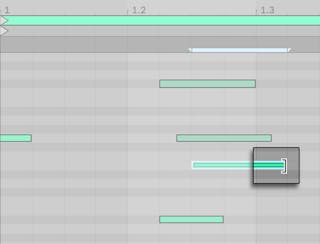
Tip: To set a group of notes to the same length, select them all, catch the end of the longest one, drag them all down to aught length so extend them.
10.four.six The ...Fourth dimension Commands in the MIDI Editor
The standard clipboard commands like Cut, Re-create and Paste only impact the currently selected notes (or the notes inside a time selection). Only, as in Organisation editing (see 6.10), there are "... Time" commands that act upon the entire MIDI clip past inserting and deleting time.
Note that these operations do not change the clip start/end position or the loop brace settings.
- Duplicate Time places a re-create of the selected timespan into the clip, along with whatever independent notes.
- Delete Time deletes a selection of time from the MIDI clip, thereby moving whatever notes on either side of the deleted expanse closer together in the timeline.
- Insert Time inserts every bit much empty time as is currently selected into the clip, before the option.
10.four.vii Quantizing Notes
There are iii options for quantizing MIDI notes in Live. First, you lot can quantize MIDI notes as you record them (see 17.5). Secondly, as previously mentioned, you can motion notes so that they snap to the visible grid lines. Finally, you can select a annotation or notes and cull the Quantize control from the Edit menu, or use the CTRL-U(Win) / CMD-U(Mac) hotkey. The starting time time you do this, you lot will see a dialog box with several quantization options. This will quantize using default settings, or the settings that you previously applied.
To accommodate your quantization parameters, open the Quantization Settings dialog from the Edit menu.
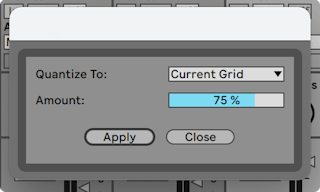
Using the options presented here, you tin can select either the current grid size or a specific meter value for quantization and fix either the note start or end (or both) to be quantized. Quantizing the note finish will stretch the note so that it ends at the called meter subdivision. You can as well quantize notes without giving them that "quantized" feel using the Amount command, which will motion notes only by a percent of the set quantization value.
10.4.viii Editing Velocities
To change velocity for a MIDI note, click and elevate on the associated marker in the Velocity Editor. Velocity values will be shown numerically in the Velocity Editor'southward lane header. To aid you locate the velocity marker belonging to a MIDI notation that may be stacked vertically with others, Alive highlights the velocity mark for whichever annotation your mouse is hovering over.
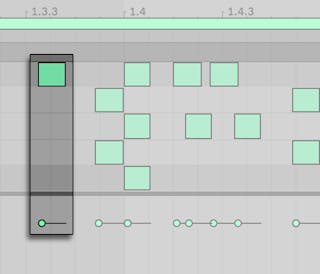
As in the MIDI Annotation Editor, y'all tin can select multiple velocity markers to change by clicking with the Shift modifier held downwards.
Tip: To set a grouping of notes so that they all have the same velocity, select their markers in the Velocity Editor, elevate them up or downward to either maximum or minimum velocity, and then adjust velocity to the desired value.
Equally we saw earlier, Draw Fashion allows drawing identical velocities for all notes within a grid tile. While in Draw Mode, velocity drawing is limited to only those notes that are currently selected. To draw markers individually (every bit yous would desire to with a crescendo, for instance) conciliate grid snapping with the CTRL-4(Win) / CMD-iv(Mac) shortcut, or only concur down the ALT(Win) / CMD(Mac) modifier.
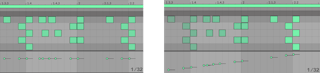
Tip: To draw a velocity ramp with notes that are all in the aforementioned key track, click a key in the piano roll to select all notes within the desired key track. Make certain Draw Mode is activated and depict the ramp into the Velocity Editor. This will bear on only the selected notes.
Tip #2: To draw a linear velocity ramp beyond a pick of notes, outset select the notes that should exist afflicted (using the Shift modifier to select non-adjacent notes if necessary). Make sure Draw Manner is activated and draw the line into the Velocity Editor while holding the CTRL(Win) / ALT(Mac) modifier.
Each note in the MIDI Note Editor displays its velocity by the amount of shading in that note's colour — calorie-free notes play softly, and vice versa. To change the velocity of notes without the Velocity Editor open, click whatsoever selected note and elevate vertically while pressing the ALT(Win) / CMD(Mac) modifier.
While pressing the CTRL(Win) / CMD(Mac) key, vertical movements in Depict Manner represent to velocity changes. This means that, with 1 horizontal movement and ane vertical motility, you can draw multiple notes and their velocities without releasing the mouse push button. If you change velocity with this vertical movement, Live will recollect the change and employ your new velocity on any notes that yous describe afterward.
Velocity values can likewise be entered manually by first selecting the velocity mark, then typing the numerical value on the calculator keyboard and hitting the Enter key. Property the Shift key allows fine-tuning the values of selected velocity markers. When using the upward or down arrow keys with CTRL(Win) / CMD(Mac) held down, the values of selected velocity markers are incremented by +/-10.
Velocity values tin can be randomized by get-go clicking in the Velocity Editor lane, which will change the Randomize Range slider to an integer value. Clicking on the Randomize button will then randomize velocity values for selected notes (or notes with selected markers). If no markers are selected, values for all notes volition be randomized.
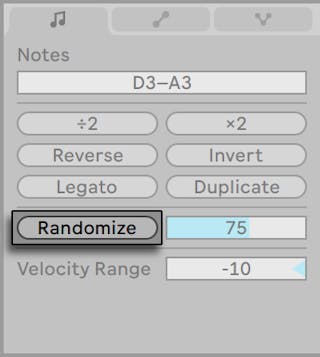
The Randomize Range slider, at the right of the Randomize push button, allows specifying a randomization range that can exist applied to velocity values. The slider'south randomization value tin can be typed as a number with the keyboard, and triggers randomization when validated using the Enter key. Velocities values will exist randomly increased or decreased by a value betwixt zilch and the number shown in the Randomize Range slider.

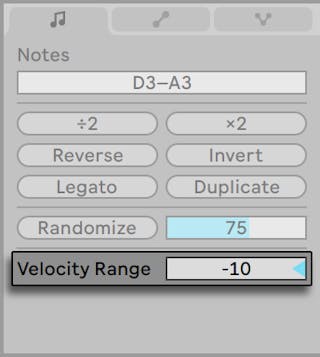
The Velocity Range slider gives further control over the range of each note past increasing the range for each note's velocity. Velocity values volition be chosen randomly from inside the range specified. For example, a note with a velocity value of 60 in combination with a Velocity Range of +twenty will be played with a randomly chosen value between 60 and 80. Positive values volition increase velocity, while negative values decrease information technology.
Holding CTRL(Win) / CMD(Mac) and dragging vertically on a velocity marker reveals a horizontal handle, which, when dragged upward or downward, sets the maximum or minimum velocity range value. The velocity range is indicated by the shaded area between the horizontal handle and the velocity marker. Double-clicking the velocity marker will reset the range to 0.
Past default, the Velocity Editor allows you to adjust note-on velocities. Just y'all tin toggle the editor to testify note-off velocities via options in the editor'southward correct-click(Win) / CTRL-click(Mac) context menu.
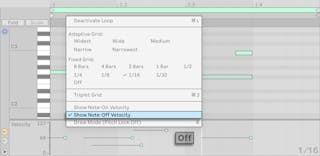
Note-off (or "release") velocity is a somewhat esoteric parameter, and is only supported by certain devices. Ableton's Sampler musical instrument (see 26.7), for example, provides notation-off velocity as a controller for a variety of parameters.
10.4.nine Editing Probabilities
The Chance Editor allows setting the probability of a MIDI notation occurring in a playing prune. The Adventure Editor lane is subconscious by default and can exist shown by clicking on its toggle push button on the left.
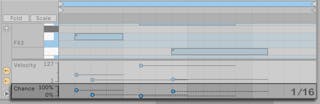
To change probability for a MIDI note, click and drag on the associated marker in the Gamble Editor. You can drag a note's probability marker upwards and downwardly to change the probability value between 0-100%. (To help you locate the probability marker belonging to a MIDI notation that may be stacked vertically with others, Live highlights the probability marking for whichever note your mouse is hovering over.) Probability changes will exist shown numerically in the Chance Editor'southward lane header.
Probability values can likewise be entered manually by first selecting the probability marker, then typing the numerical value on the computer keyboard and pressing the Enter central. Property the Shift key allows fine-tuning the values of selected probability markers. When using the upwardly or down arrow keys with CTRL(Win) / CMD(Mac) held downwards, the values of selected probability markers are incremented by +/-ten.
To randomize probability values, first click in the Gamble Editor lane. This volition change the Randomize Range slider to a percent value. Clicking on the Randomize push will then randomize probability values for selected notes (or notes with selected markers), depending on the focused lane. If no markers are selected, values for all notes volition exist randomized.
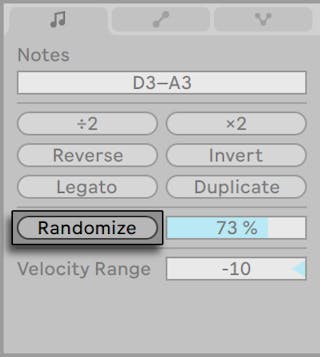
The Randomize Range slider, at the right of the Randomize push button, allows specifying a randomization range that can be practical to probability values. The slider's randomization value can be typed as a number with the keyboard, and triggers randomization when validated using the Enter key. Probability values will be randomly increased or decreased past a value betwixt nada and the number shown in the Randomize Range slider.
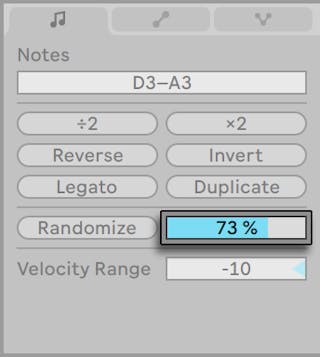
Notes with probability values less than 100% volition brandish a minor triangle on their upper-left corners, which will merely be visible if the fundamental track height is expanded enough; otherwise, it will exist hidden.
10.4.10 MIDI Notation Stretch
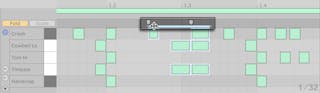
When multiple notes or a range of time are selected in the MIDI Note Editor, Note Stretch markers volition appear, allowing notes to be scaled proportionally in fourth dimension. The markers are a pair of downward-pointing indicators that snap to the get-go and end of the option.
Past clicking and dragging ane of the markers horizontally, the selected notes volition move and stretch so that they go on to occupy the same proportion of time that they did when they were initially selected. As with notes, Note Stretch markers can exist freely moved until reaching the previous or side by side grid or starting time bespeak, after which they volition snap to the MIDI Note Editor's filigree lines unless the grid is not shown or the ALT(Win) / CMD(Mac) modifier is held while dragging.
When the mouse is betwixt the Note Stretch markers, a "pseudo" stretch marking will appear. Dragging this stretches or compresses the fabric between the fixed markers without affecting the cloth outside of them. The pseudo stretch marker has the same grid snapping beliefs equally fixed markers.
When notes (merely not time) are selected, ane marker tin be dragged beyond the boundary of the other, which volition "reflect" the social club of the stretched notes in relation to their initial sequence; this is sometimes referred to as "retrograde" behavior.
Adjusting the Note Stretch markers will also adjust the timing of any of the clip's linked clip envelopes. Unlinked clip envelopes are not afflicted.
10.iv.eleven Cropping MIDI Clips
MIDI data that is outside of the loop brace tin be deleted by means of the Crop Clip command. Simply right-click(Win) / CTRL-click(Mac) on a MIDI prune in the Session or Arrangement View and select this option. Unlike cropping audio clips (encounter viii.2.eight), cropping a MIDI clip does not create a new file on disk.
x.four.12 Deactivating Notes
To conciliate, or mute, a note (or notes) in the MIDI Editor, select information technology and press 0. The Deactivate Note(s) command will mute the annotation, making it appear grayness in the display. Printing 0 again to reactivate notes. You tin de- or reactivate all of the notes in a unmarried key track at one time by clicking a fundamental on the pianoforte roll and pressing 0.
ten.4.13 The Transform Tools
In improver to the editing possibilities inside the MIDI Note Editor itself, the Notes tab/panel's transform tools (run into 8.3) offer a number of ways to apace manipulate the notes within a MIDI clip.
10.5 Multi-Clip Editing
In the MIDI Note Editor, you tin can view notes in multiple MIDI clips at the same fourth dimension. This helps you lot to see melodic and rhythmic relationships between different clips when creating and refining musical ideas, and allows you to edit textile beyond divide tracks and scenes more quickly. In add-on to editing notes across multiple clips, you lot can also change various parameters for the selected clips.
When multiple MIDI clips are selected:
- The notes from these clips will exist shown together in the MIDI Note Editor. Y'all tin select and edit notes from multiple selected clips at the same time, or use Focus Manner (see x.v.1) to edit notes in a single clip while notes from other clips are still in view.
- Loop bars volition announced above the MIDI Note Editor. Each loop bar represents a unlike clip in the current selection, and the colors of the loop bars match the color of the prune. Clicking on a clip's note or loop bar switches to that clip for editing.
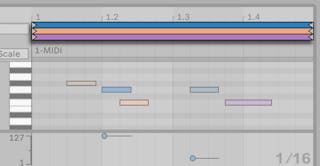
- You can adjust the loop length for any single clip by clicking and dragging its loop bar marker. You tin as well select and edit loop confined from whatever of the selected clips simultaneously, by clicking or dragging their loop markers while pressing the CTRL(Win) / CMD(Mac) key. Using the Shift primal allows you lot to select contiguous loop bars. (Note: With Focus Mode enabled, it is non possible to select more than one loop bar at a time, and any existing multi-option is ignored.)
- You tin indistinguishable selected loop bars using the right-click(Win) / CTRL-click(Mac) context menu option.
- The championship bar will evidence the name of the prune selected for editing. This can exist particularly useful for identifying different clips with the same color. (Annotation: if a clip has no proper name, the championship bar will display the name of the track containing the prune instead.)
- Certain controls in Clip View (see 8.1) announced when multiple MIDI clips are selected and are editable for all selected clips. These controls include Loop settings, Clip Time Signature, Clip Groove settings, and Scale Manner settings.
- Fold and Fold to Calibration settings can all exist edited for all selected clips.
- Randomization of velocity and probability values is only ever applied to a single prune at a time. It is not possible to randomize these values for all notes in all selected clips.
- Yous can resize the loop bar region by clicking and dragging straight above the multi-clip title bar's scrub area.
Note that multi-prune editing works differently depending on whether you lot are working in the Session or Organization View. These differences are explained in dedicated sections for the Session View (meet ten.five.ii) and the Arrangement View (see 10.5.3) further down in this affiliate.
10.5.1 Focus Mode
Focus Way allows you to select a single clip to edit while viewing multiple clips. Focus Fashion tin be toggled via the Focus button or the N keyboard shortcut. Belongings N while editing with the mouse toggles Focus Mode momentarily. Multi-clip editing functions differently depending on whether Focus Mode is enabled or not.
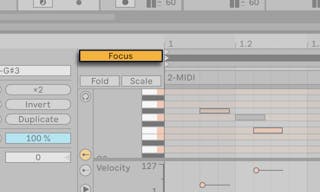
When Focus Mode is enabled:
- The active prune's notes will exist shown in that clip's color, while the inactive clips' notes will exist shown in gray.
- The agile prune's loop bar will be shown in black, while the inactive ones will be shown in grey.
- The name of the active clip is displayed below the loop confined.
- Hovering the mouse over an inactive clip's notes or loop bar volition reveal that clip's color, helping you to choose a different clip in the electric current selection to edit. Clicking on a prune's note or loop bar switches to that clip for editing.
- The loop length controls and Notes tools are available for editing the agile prune.
- Enabling Scale Manner displays the root note and scale name for the currently selected clip.
- If Fold to Scale is enabled, key tracks for all scales through all selected clips will exist folded. Enabling Fold will disable Fold to Calibration and instead fold all key tracks beyond all selected clips.
- The Transpose, Reverse, Invert, Legato and Duplicate controls in the Notes tab/panel only applies to the active clip.
When Focus Way is disabled:
- All notes are displayed with their clip'southward color, as all notes are agile.
- A prune'southward loop bar will turn blackness when clicking on it, which and then allows you to randomize Velocity or Chance for notes within that prune past first-clicking. The non-selected loop brace will display the color of its clip.
- Enabling Scale Mode displays the root note and scale name for the currently selected clips just if they are the same across all clips. Otherwise, an asterisk is shown where unlike root notes or scale names are called.
- The Transpose, Reverse, Invert, and Legato controls in the Notes tab/panel apply to all selected clips. Note that at to the lowest degree 1 note must be selected in order for the Reverse, Invert, and Legato controls to function.
- The Duplicate, Play at Half Tempo and Play at Double Tempo functions can be applied to multiple notes across selected clips.
- Notes can exist cutting or copied from multiple clips and inserted into the same set of clips, every bit long as the clip selection/foreground clip has non changed, or into a different clip in one case that new prune has been selected.
- Notation editing functions (eastward.g. copy, cutting, paste, delete) can exist used when working with notation selections across clips and loop boundaries.
- Time in the MIDI Note Editor can exist selected beyond loop and clip boundaries.
ten.5.2 Editing in the Session View
In the Session View, you tin select and view upwards to eight looped MIDI clips at the aforementioned time. In the MIDI Notation Editor, loop confined are ordered vertically (get-go by rails, and so by scene).
If multiple clips of different lengths are selected, the MIDI Note Editor will show as many loop iterations as necessary for the clips to realign. Loop points are represented by black vertical lines in the MIDI Note Editor. Clips with a start marker gear up before the loop starting time are represented by a bar at the top of the MIDI Note Editor.
While multi-clip editing is useful for looking at clips across unlike tracks, it tin can likewise come in handy when y'all need to compare and edit multiple clips within the aforementioned rail. For instance, you can create evolving pattern progressions by calculation notes to a clip, then making a variation to the clip in the following scene and so on, while maintaining an overview of the other clips in the track.
10.5.3 Editing in the Arrangement View
In the Arrangement View, information technology is possible to select and view MIDI clips from up to eight tracks, beyond a selection of time. In the MIDI Annotation Editor, loop bars are ordered vertically past track and horizontally by time.
Notes tin be fatigued continually across prune boundaries, except in Focus Manner.
The MIDI Note Editor will not show silence before or after the option of clips – instead, it will fit its display range to show the outset of the first prune up to the finish of the concluding clip in the selection. If the selection contains looped and unlooped clips, the Loop push button will appear half colored.

Source: https://www.ableton.com/en/manual/editing-midi-notes-and-velocities/
Posted by: blackmermexamo.blogspot.com
0 Response to "How To Draw Notes In Ableton"
Post a Comment